
You are still closing work. But the next level keeps slipping. This post separates an owner bottleneck from a sales system gap so you can fix the right problem first.

Key Takeaway: If growth feels stuck, the bottleneck is usually either you or a sales system your team cannot run without you. Use the Sales Stalling Matrix and a 60-day owner dependency audit to pinpoint the real constraint, then raise Bid Win Rate and Average Deal Size on A-profile work.
You are in the small conference room with the whiteboard that never feels big enough. Last three months of revenue are on the board in blue. Job names and GCs in black. Two ugly margins circled in red.
Your ops lead leans back in the chair. Your sales lead has half a page of numbers and half a page of worries. On paper, it was not a bad quarter.
• Bids went out steady
• Crews stayed busy
• Nothing truly crashed
But the board tells a different story.
• Hit rate on the work you actually wanted feels soft
• A couple of bigger opportunities slipped away without a clear reason
• Profit did not move the way all that busyness should have
You can feel two thoughts pulling at you. One says, I am still too deep in this thing. I am the lid. The other says, Our sales system is still a patchwork of habits, not a machine.
This post is about that tension. In numbers and patterns you can see, not just in feelings.
If you are thinking about an HVAC business coach to break the sales ceiling, read HVAC Business Coach vs TradeSworn first so you can tell whether the constraint is owner-dependency, a missing sales system, or both.
Reality
Growth Stalls In Four Predictable Ways.
Most owners talk about growth like it is one thing. It is not. If you look at behavior instead of emotion, almost every shop that feels stuck lands in one of four patterns.
Picture a simple grid.
• Up and down is Strategy: how clear you are on the kind of work and customers you actually want
• Left and right is System: how strong your sales process, tools, and training are so the team can go get that work without you carrying it all
Inside that grid, you get four quadrants.
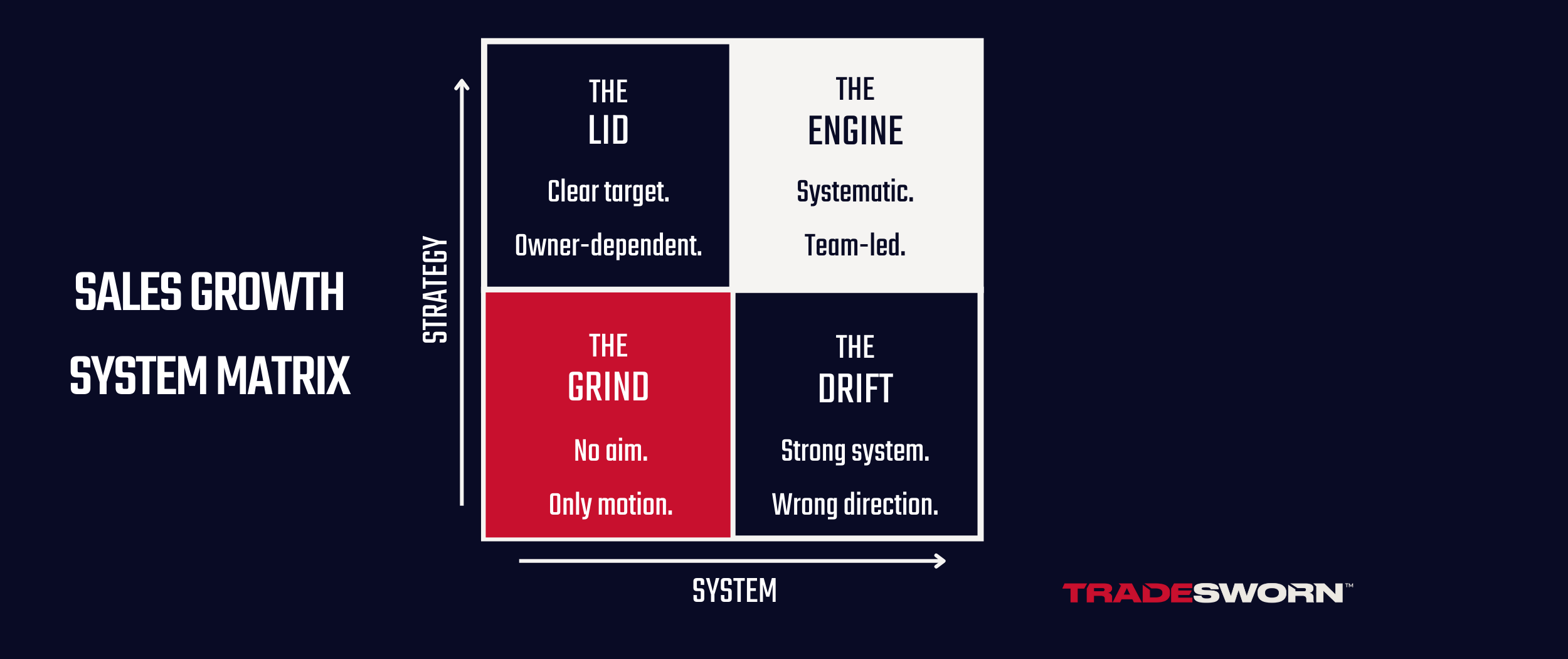
Q1: The Grind (Low Strategy, Low System)
You take what comes. Everyone chases whatever hits the inbox. No clear targets, no consistent process. Results are random. Owner feels busy, not leveraged.
Q2: The Lid (High Strategy, Low System)
You know what good work looks like. The problem is everything important still needs your eyes. You touch most big estimates, key pitches, and pricing decisions. You are the bottleneck whether you mean to be or not.
Q3: The Drift (Low Strategy, High System)
You have a polished sales routine pointed at the wrong opportunities. You execute well on low margin work or the wrong GCs. The team feels productive. The P and L stays flat.
Q4: The Engine (High Strategy, High System)
You are clear on the work and customers you want. The system is strong enough that the team can pursue it without everything flowing through you. Bid Win Rate and Average Deal Size move in the right direction over time, not just in lucky bursts.
Most shops have pieces of all four. The point is not to label yourself forever. It is to be honest about where you spend most of your time right now.
Fix It
Run One Honest Audit Before You Change Anything
Before you change your role or rebuild the system, you need proof of where the stall really lives. Two numbers will tell you more than opinions:
• Bid Win Rate on the work you actually want
• Average Deal Size on the work you actually win
Then you layer owner dependency on top.
Pull the last 60 days of bids that mattered:
• Above a certain dollar value
• Or that fit your “real growth” profile
For each bid, mark:
• Did it require your approval, rewrite, or direct involvement
• How many days it waited on you
• Whether you won or lost
You might end up with something like this:
• Total bids over 60 days: 20
• Bids the owner touched directly: 16
• Owner dependency: 80 percent
Add simple performance:
• Average wait time when owner involved: 3.8 days
• Win rate when owner involved: 35 percent (6 wins out of 17 decided)
• Win rate when owner not involved: 42 percent (3 wins out of 7 decided)
If you see high owner dependency, long wait times, and no meaningful lift in win rate when you get involved, you are not just dealing with market conditions. You are sitting in The Lid.
Now zoom out on your target work.
Example for the past year:
• Annual bids on target work: $5,000,000
• Current Bid Win Rate: 20 percent
• Closed revenue: $1,000,000
If you move win rate to 25 percent without changing lead volume:
• Same bids: $5,000,000
• New Bid Win Rate: 25 percent
• Closed revenue: $1,250,000
That is $250,000 more revenue from the same opportunities, just by fixing how you sell and follow up. You can layer in deal size:
• Current average deal size: $80,000
• With better targeting and mix: $95,000
Better win rate and better deal size on the right work is what a real Sales Growth system does. It is not about yelling “more leads.” It is about moving those two numbers on purpose.
Reality
Me Versus System Is An Exit Question
Owners often treat this as a personality problem. “If I were a different kind of leader, growth would not be stalled.”
Buyers do not see it that way. They look for structural risk:
• How many key relationships live only in your phone
• How many estimates hinge on your personal judgment
• How many deals close only if you are in the room
Two shops can have the same revenue and similar margins. The one that depends less on the owner usually gets the better multiple.
Simple illustration:
• Shop A
• $6M revenue
• $900K adjusted EBITDA
• Owner touches 80 percent of large bids and key customers
• Likely multiple: 3.5 to 4.0x
• Exit value: around $3.2M
• Shop B
• $6M revenue
• $900K adjusted EBITDA
• Owner touches 20 percent of large bids, team runs the system
• Documented process, visible Bid Win Rate tracking
• Likely multiple: 4.5 to 5.0x
• Exit value: around $4.3M
Same income. Roughly one million dollars of difference because one business is an engine and the other is an extension of the owner.
Separating “me” from “system” is not a self help exercise. It is an exit value decision.
Fix It
Use The Sales Stalling Matrix To Pick Your First Move
Once you have the numbers, you can decide what to fix first instead of trying to fix everything. Look at your owner dependency audit, win rate, and deal size, then ask:
1. Are we clear on the work we want more of, or are we taking almost anything
2. Do we have a repeatable way to qualify, price, propose, and follow up, or is it different by salesperson
3. How often does our system run without me sitting in every key seat
If you are:
• Saying yes to everything, you are in The Grind or The Drift
• Clear on strategy but everything still flows through you, you are in Owner As The Lid
• Running a clean process at the wrong work, you are in The Drift
m
From there, you pick one quadrant to move out of:
• Grind: first move is clarity on target work and customers
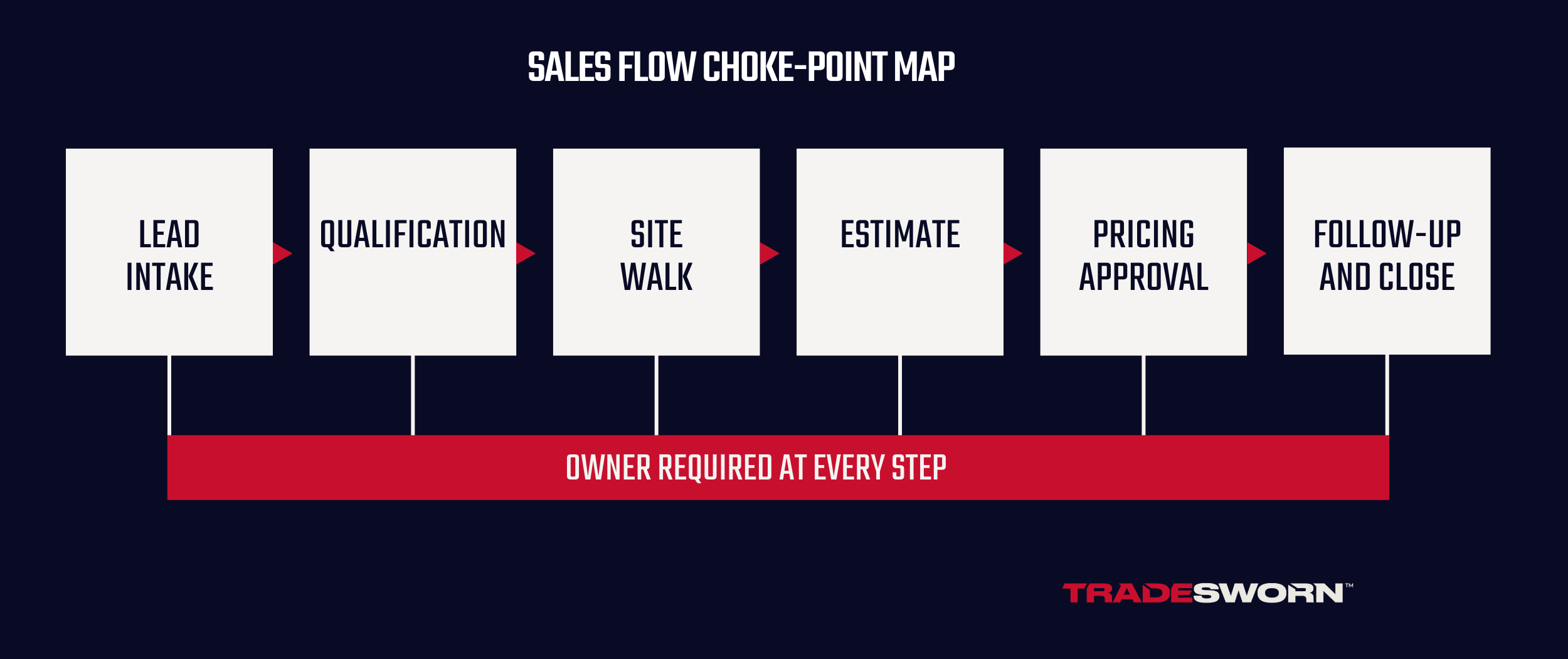
• The Lid: first move is to pull yourself out of one choke point in the sales flow
• Drift: first move is to stop pointing a good process at low value jobs
• Engine: first move is to protect and refine, not jump three weight classes at once
You are not changing who you are. You are choosing which part of the machine to fix first.
Pro Move
Change One Owner Habit And One System Habit Together
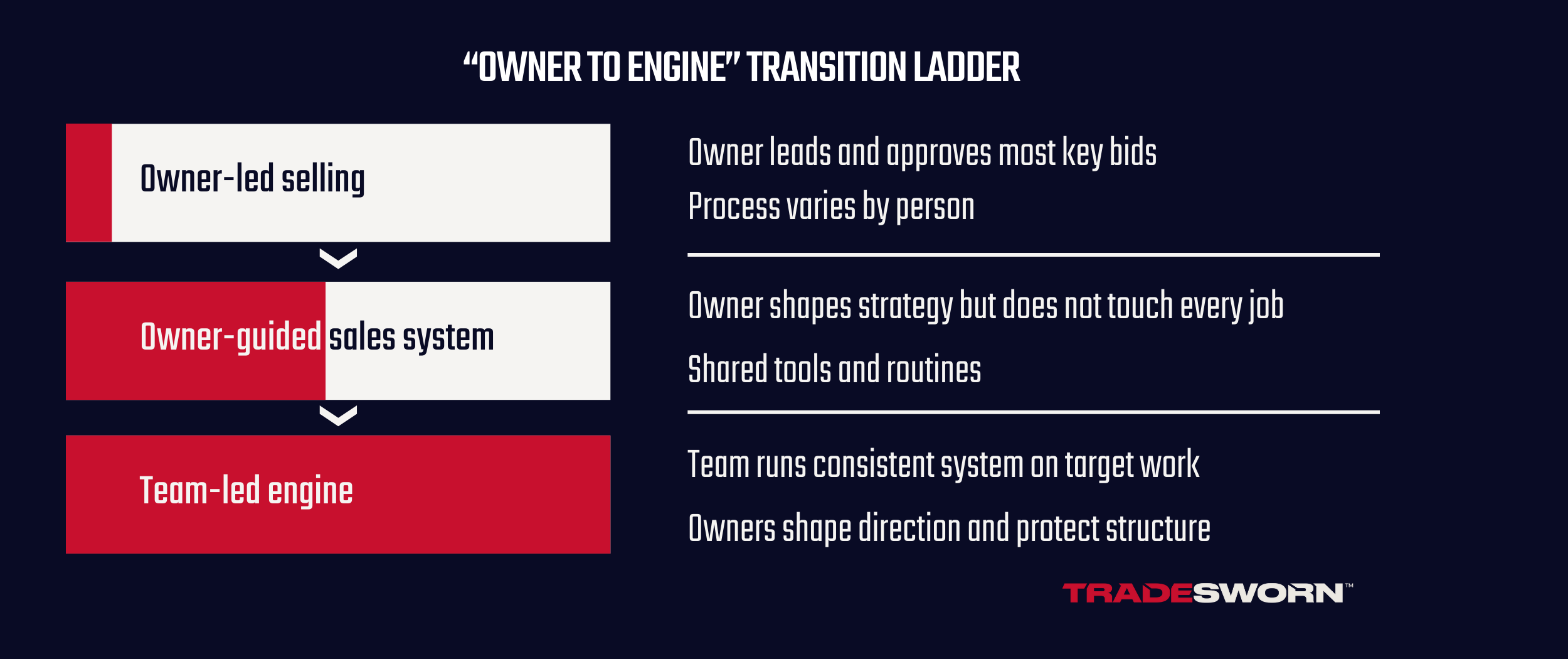
You get more movement when you adjust both sides at once:
• One change in how you show up
• One change in how the system works without you
Pick something you can see on the calendar and on the scoreboard.
Owner side ideas:
• Stop being the second estimator on every big job. Set direction for the first fifteen minutes, then let the team run the details.
• Block two hours once a week to review scorecards and patterns, not individual quotes.
• Be in the early discovery calls where you can shape strategy, not in every last minute pricing decision.
System side ideas:
• Standardize a simple discovery sequence and proposal skeleton for jobs over a certain size.
• Require live reviews for any quote above a set threshold. No more sending big numbers cold.
• Log every bid over that threshold into your Bid Win Rate Scorecard with outcome, deal size, and whether you were personally involved.
When you do both, people feel it. The team sees you becoming a coach instead of a fixer. You see that the system can move win rate and deal size without every decision running through you.
Quick Win
A 30 Day Sales Stalling Check
You do not need a full year to see if growth is really stalled because of you, the system, or both. Over the next 30 days:
1. Track every meaningful bid in a simple table:
• Date
• Customer or GC
• Estimated value
• Did you touch it (Y or N)
• Date it went out
• Outcome
2. At the end of the month, calculate:
• Bid Win Rate on owner touched jobs
• Bid Win Rate on team run jobs
• Average Deal Size in each group
• Average days from walk to proposal in each group
3. Circle patterns like:
• High owner involvement with no better win rate
• Longer cycle time when you are involved
• Smaller average deal size when you jump in late and get nervous about price
If those show up, your question shifts from “Is growth stalled by me or our system” to “Where do I change my role and where do we upgrade the system first.”
You will know you are ready for the next step in the stack when you can see, in black and white, that the bottleneck is not just pace of work but which work you are chasing. That is where “Where’s The Real Growth Hiding?” picks up the story.
You already know how to stay busy. The real question is whether you are building an engine the team can run or a job that only works when you are in the room.
When you:
• Map yourself honestly on the Sales Stalling Matrix
• Run a 60 day owner dependency audit
• Track Bid Win Rate and Average Deal Size on the work that matters
• Change one owner habit and one system habit at the same time
You stop guessing about whether you are the lid or the machine is. You can see it.
Your Bid Win Rate Scorecard and your Sales Growth Workplan exist to turn that into a structure, not just a realization. You do not fix all four quadrants in a month. You pick one move on the “me” side and one move on the “system” side and point them both at better win rate and better deal size on the right work.
That is how “I might be the lid” turns into “I am building the engine.”
If you are trying to figure out why sales growth feels stuck or why revenue is not translating into the profit and valuation you expected, work this stack over 30 to 60 days.
1. You are here: Is Growth Stalled By Me Or Our Sales System?
Run the Sales Stalling Matrix and owner dependency audit so you can see where the real bottleneck lives.
2. Then: Where’s The Real Growth Hiding?
Use A B C job analysis to find which work actually builds profit and enterprise value, not just top line.
3. Next: Why Isn’t Our Pitch Closing More Jobs?
Shift from technical quotes to risk and outcome driven pitches that raise Bid Win Rate on the jobs you actually want.
4. Then: How Do We Charge More And Win?
Put a real floor under your pricing, build proof, and use simple tiers so you can hold your number and still close.
5. Finally: How Do We Break Into Bigger Jobs?
De-risk yourself in the eyes of GCs and owners, prove capacity, and climb into bigger work one weight class at a time.
Run your Scorecard alongside these posts so you can see the impact in real numbers. When you are ready to turn this from reading into a full system, it is time for your Sales Growth Workplan.

Here are the top toolkits HVAC owners are reading, using, and sharing to work smarter every week.

Growth isn't in stranger hunting, it's hiding in A-job upgrades, renewal lanes, and multi-site expansions with customers who already trust you.

Land $250k-plus jobs by proving you can carry risk (not by cutting price) using the strategies elite shops build before they ever bid.

Lead with risk plans not equipment lists, tier your offers, and win at higher prices by making your number feel safer than your competitors.

If your team’s relying on charm, hustle, or guesswork to win jobs, it’s time for a system. Learn how elite shops sell consistently and at a premium.

No spam. Get real advice and proven tactics to win more jobs and keep more profit.
“We cut the noise, ran the plan, and made more in two quarters than we did all last year.”
— Sean, Massachusetts

