
Most stalled exits are not about “market timing.” They are about owners not knowing whether the real blocker is their own head, the way the business runs, or both. This toolkit helps you sort that out so you can stop drifting and pick the right next move.

Key Takeaway: Most exits do not stall because “the market is weird.” They stall because either you are not ready, the business is not ready, or both. Once you see which side is really holding things up, you can stop blaming the calendar and start building a real exit lane.
You are on the phone with your broker. Again.
Last year, you said you were probably twelve to eighteen months out from wanting to sell. This year, you are saying the same thing. Your story has not changed much:
• “The market feels strange right now.”
• “We need one more strong year.”
• “I want to clean a few things up before we really go to market.”
None of that is wrong. But something is off. The business is not falling apart. Revenue is decent. Crews are busy. You have a list of GCs and customers who would vouch for you. On paper, this could be a sellable shop.
At the same time, you are tired. Your calendar is full. Every week, your “exit work” loses to whatever fire popped up in operations. You keep telling people your exit is “about a year away.” You have been saying that for three. So what is actually stalling this exit:
• You,
• The business,
• Or both.
This toolkit is here to help you answer that honestly, before you wake up five more years down the road still “twelve to eighteen months out.”
If you are considering an HVAC business coach or consultant as you prep for a sale, read HVAC Business Coach vs TradeSworn first so you choose support that improves exit readiness, not just your timeline story.
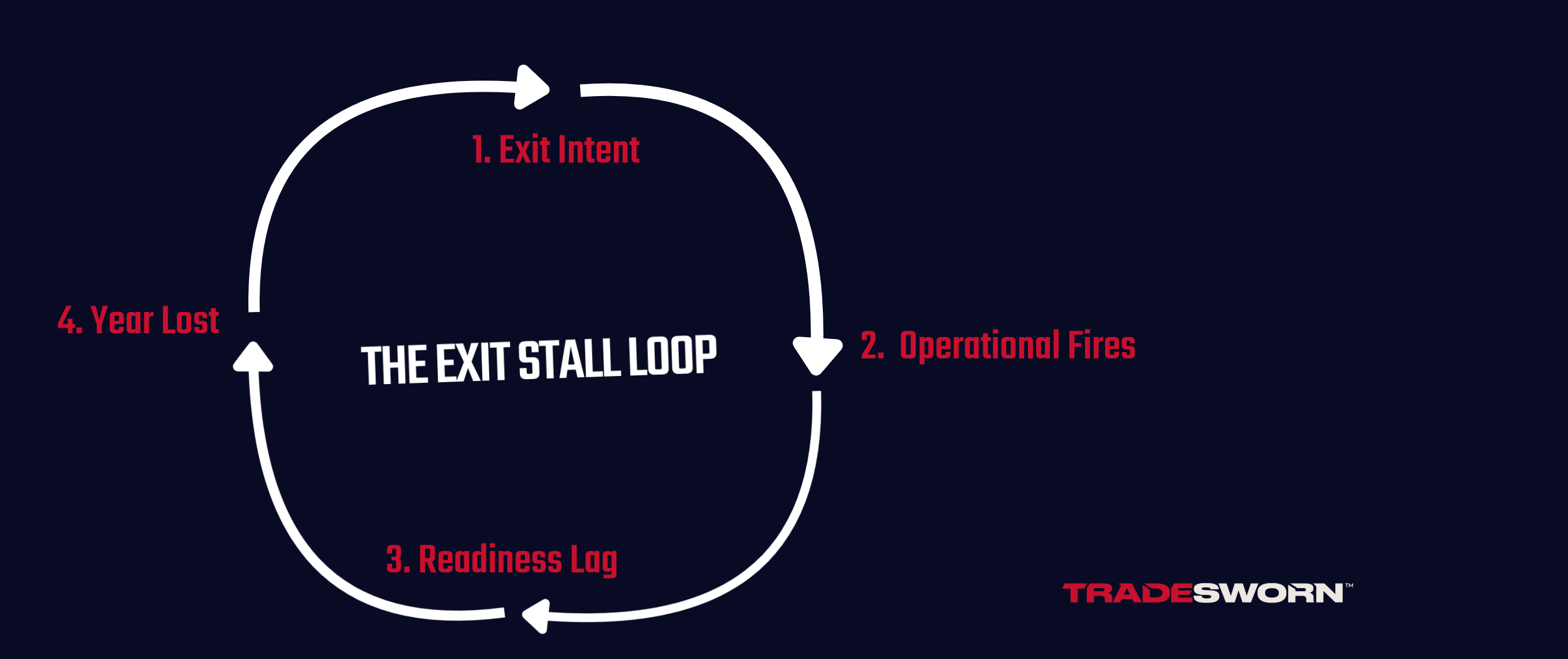
Most owners bundle everything together and call it “timing.” In reality, there are two separate questions hiding under that word:
1. Am I personally ready to make a move?
2. Is this business ready to be sold to someone else?
You can be stuck on either side, or both.
• You might be emotionally ready to move on, but the company still leans on you too hard.
• The business might be running well, but you have not sorted out what you really want next.
• Or you might be in the roughest place of all: burned out and tied to a company that still looks too risky for top of market terms.
Treating all of that as “the market” hides the real work.
The 2 x 2: Me vs the business
Picture a simple grid. Left to right is Business Readiness. Bottom to top is Owner Readiness.
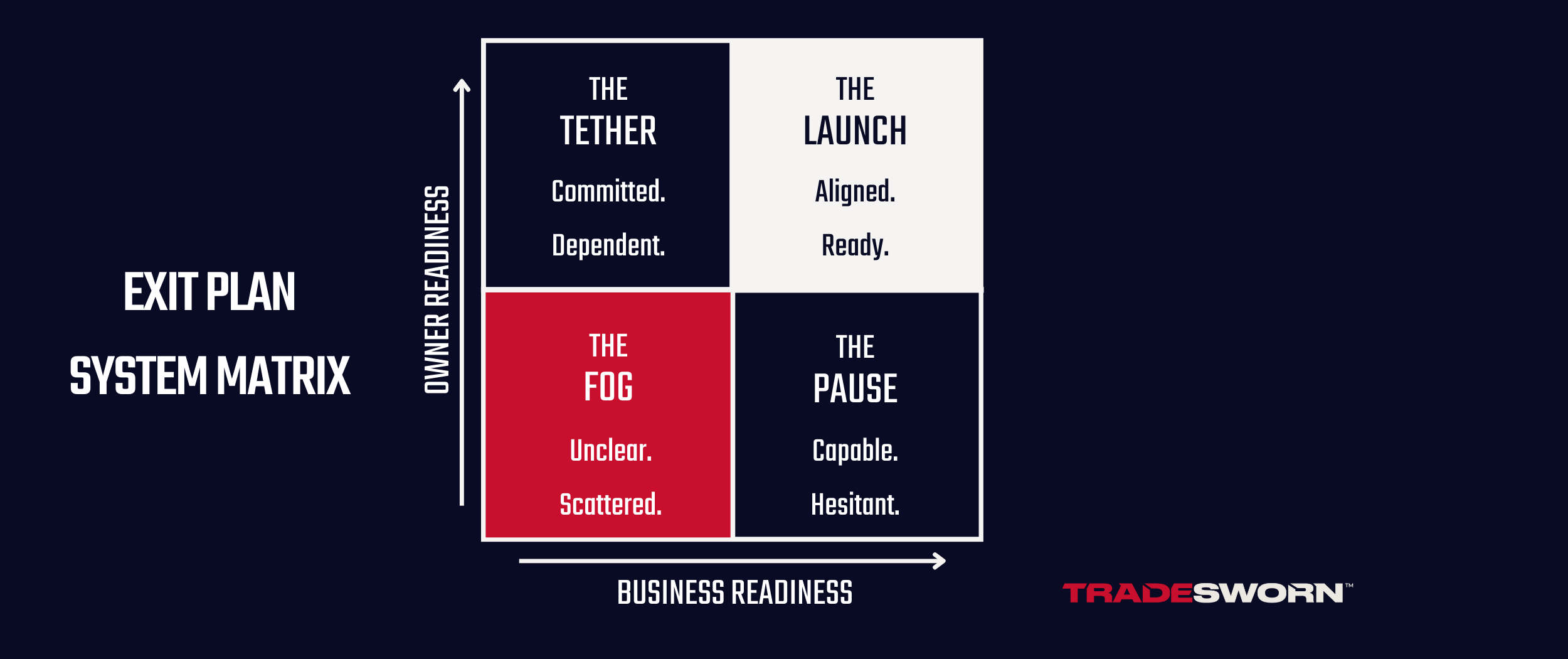
You end up in one of four quadrants:
1. Bottom left: Low Owner, Low Business
Stuck in the fog. Always busy, never prepared.
2. Top left: High Owner, Low Business
Escape hatch territory. You want out more than the business can support.
3. Bottom right: Low Owner, High Business
Nice machine, hesitant driver. The company could go, but your head is not there yet.
4. Top right: High Owner, High Business
Deal on your terms. This is where you want to be when real offers show up.
Your first job is not to “pick a date.” It is to figure out which quadrant you are actually in.
Start with the Part Nobody Else can See on a Spreadsheet.
Reality
Owner readiness shows up in very plain ways:
• You think about selling at least once a week.
• You are more excited about “after” than about fixing what is in front of you.
• You feel guilty at home and overloaded at work.
• You find reasons to delay real exit work, then feel frustrated with yourself.
It is easy to blame all of that on the business. Some of it is about you:
• Your energy.
• Your identity.
• Your fear of regret.
• Your uncertainty about what comes next.
None of that makes you weak. It makes you human.
Fix It
Ask three questions and actually write the answers down:
1. If I sold in the next one to three years, what do I want life to look like afterward?
2. If I did not sell in the next one to three years, what would I want life and work to look like instead?
3. What am I most afraid of: selling too early, selling too cheap, or never selling at all?
You are not signing a contract. You are surfacing what has already been running in the background.
Pair this with “How Do I Exit Without Burning Out?” if you recognize yourself in the burnout patterns.
Pro Move
Have one honest conversation outside of the business. Pick someone who:
• Knows you well,
• Does not have money in the company, and
• Will tell you the truth.
Walk them through what you are thinking. Listen for the moment where you start to talk in circles. That is usually where you are stalled.
Quick Win
On one piece of paper, draw a line down the middle. Label one side “reasons I want to move on” and the other “reasons I want to stay.” Do not censor. Do not try to make it sound smart. Just fill it.
When you look at that page later with clearer eyes, you will often see that the stall is more about one or two real fears than “the timing is not right.” Those fears are work you can do.
Now Look at the Part a Buyer Actually Writes a Check For.
Reality
Business readiness is not the same as having a good year. Serious buyers care about:
• Earnings, especially adjusted EBITDA.
• How stable those earnings are.
• How much risk they are taking on if you walk away.
• Whether the business is explainable and repeatable without you.
You can be pulling long hours and still have a company that is not very sellable:
• Revenue built on a handful of GCs.
• Heavy on big projects, light on recurring work.
• Jobs that rely on a few heroes instead of systems.
• Financials that need a story to make sense.
You can also quietly have a business that is much stronger than you think, but you have never seen it through a buyer’s eyes.
Fix It
Run a very simple, honest test:
• Revenue mix: How much is service and maintenance versus project work.
• Profit: What is your real adjusted EBITDA over the last twelve months.
• Customer risk: What percent of revenue comes from your top five customers.
• Owner dependence: Which key decisions absolutely require you.
• Systems: Can you explain how work moves from lead to cash on one page.
You do not need perfect answers. You need something better than “I think we are fine.”
Then run the Buyout Potential Scorecard on the Scorecards page. It is designed to score your shop on the same basics a buyer will care about. It gets you out of wishful thinking and into measurable reality.
Pro Move
Write down your first reaction to that score.
• If you are surprised on the upside, your stall might be more about you than the business.
• If you are not surprised but disappointed, your stall is probably more about the business than you.
Either way, you now have a sharper “business side” read than you did before.
Quick Win
Pick one metric that bothers you the most:
• Customer concentration.
• Thin maintenance base.
• Owner dependence.
• Margin pattern.
That metric is the business half of your stall. Circle it. It will matter later when you build an exit lane.
Now that you have a clearer view of both sides, place yourself on the 2 x 2. Be honest. It is just for you.
Quadrant 1: Me not ready, business not ready
This is the bottom left. You are tired, the company leans on you heavily, and there are still obvious risks a buyer would see. Typical signs:
• You talk about selling often but do very little to prepare.
• The business feels like something that is happening to you, not something you can shape.
• You feel guilty that you have not “gotten serious about exit” yet.
What to do:
This is not the moment to pick a sale date. It is the moment to stabilize:
• Use “How Do I Exit Without Burning Out?” to reduce the worst pressure points.
• Use “Am I Actually Ready to Sell My Company?” to see what “sellable” really means.
• Use the Buyout Potential Scorecard as a baseline.
Your next goal is not a signed LOI. It is to move yourself and the business closer to the right and up on the grid.
Quadrant 2: Me ready, business not ready
This is the top left. You are emotionally done, or close to it, but the shop still looks risky from the outside. Typical signs:
• You say things like “If someone gives me a check, I am gone.”
• You are tempted to grab the first decent offer regardless of structure.
• Your broker is more excited about going to market than you are about cleaning up basics.
What to do:
Resist the urge to treat exit as a fire escape.
• Tighten up the business side using “Am I Actually Ready to Sell My Company?” and “What’s My HVAC Company Actually Worth?”
• Aim the next twelve to twenty four months at improving both your numbers and your risk profile.
• Use the Exit Workplan as a way to sequence that work so you do not burn yourself out before value shows up.
The goal here is to avoid selling a still dependent, messy business on terms you will regret.
Quadrant 3: Me not ready, business ready
This is the bottom right. The company is in relatively good shape, but you are not sure what you want next. Typical signs:
• Your leadership team carries real weight.
• The numbers are stable and explainable.
• You keep finding reasons to “wait one more year” even though the business could likely attract interest.
What to do:
Give yourself space to think deliberately.
• Work through “How Do I Exit Without Burning Out?”, not because you are burned out, but because it helps you think about your role and your life after a potential sale.
• Clarify your personal “why” for selling or staying.
• Consider that waiting for everything to be perfect often masks a simple truth: you are not ready to let go yet.
No buyer can solve this quadrant for you. This is personal work.
Quadrant 4: Me ready, business ready
This is the top right. You are clear on why you want to move on, and the company looks like something a serious buyer would pay for. Typical signs:
• You have a decent handle on adjusted EBITDA and where your value range likely sits.
• Customer concentration and owner dependence are not perfect, but not terrifying.
• You have leaders who run real parts of the business.
• You are more interested in a good process and the right buyer than in dragging this out forever.
What to do:
Here, the stall is often about lack of a clear path, not lack of readiness.
• Lock in your valuation reality with “What’s My HVAC Company Actually Worth?”, then check it against current EBITDA multiple ranges by business profile
• Protect your energy and deal quality with “Am I Being Rushed and Lowballed?”
• Use the Exit Workplan to structure how you go to market instead of wandering toward the first offer.
You are not “stalled.” You are staged. You just need a disciplined plan.
For a practical structure you can mirror, use FINRA’s Regulatory Notice on succession planning.
Once you know your quadrant, your exit stops being a vague date and starts becoming a lane. A lane has:
• A direction.
• Guardrails.
• Milestones.
• A realistic speed.
Reality
You cannot fix everything at once. You can:
• Improve your own readiness.
• Improve the business.
• Decide, in a calm moment, what kind of outcomes you will and will not accept.
The stall does not come from a single missing trick. It comes from treating your exit as an idea instead of a project.
Fix It
Pull your notes together:
• Your “Me” side answers.
• Your business side metrics.
• Your quadrant on the grid.
• Your Buyout Potential Scorecard result.
Then ask three questions:
1. If I do nothing, where will I be three years from now: same quadrant, better, or worse.
2. What would have to change in the next one to two years for me to move one quadrant up or to the right.
3. Which changes would make my everyday life better now and also raise my exit options.
Those answers are the raw ingredients for your Exit Workplan.
Pro Move
Treat the next twelve months as a test of your ability to move quadrants.
• Run the Buyout Potential Scorecard now and again in a year.
• Use each of the Exit Toolkits to work on a different side of the grid: Burnout, Readiness, Valuation, Deal quality
• Use an Exit Workplan as the central project list so your effort compounds.
If you realize along the way that you do not want to sell yet, that is fine. You will still own a calmer, more valuable business.
Quick Win
Before you click away from this page:
1. Write down which quadrant you are in.
2. Write down one owner side shift and one business side shift you could start in the next ninety days.
3. Put a simple follow up in your calendar ninety days from now titled “Exit stall check in.”
You do not have to fix your stall overnight. You do have to stop pretending it is only about “timing.”
When you say “the timing is not right,” some of that may be true. The rest is usually:
• A business that still carries more risk than it needs to,
• An owner who has not sorted out what they really want, or
• Both.
None of that is a judgment. It is a starting point. Once you can say, without spin, “Right now my exit is stalled mostly by me” or “Mostly by the business,” you are finally looking at levers you can pull.
You are no longer waiting on the calendar.
If you are serious about selling in the next one to five years, you are already on the exit path. Use the Exit Stack in this order over the next 30 to 60 days:
1. You are here: What's Really Stalling My Exit: Me Or The Business?
Sort out whether the real blocker is your head, the way the business runs, or both.
2. Then run the numbers and systems check: Am I Actually Ready to Sell My Company?
Use that checklist to see whether your shop is busy or truly sellable and where your biggest risk lines are.
3. Get a realistic value view: What’s My HVAC Company Worth?
Translate earnings, risk, and buyer expectations into a range you can negotiate from and a baseline you can improve.
4. Protect your energy and deal quality: How Do I Exit Without Burning Out? and Am I Being Rushed and Lowballed?
Use these to redesign your role so you can survive the process and to spot rushed, fuzzy, or lowball offers before they set the terms.
Alongside those posts, run the Buyout Potential Scorecard once so you can see your shop through a buyer’s eyes.
When you are ready to turn this from reading into a real plan, request your Exit Workplan. We will use your Buyout Potential Score, your actual numbers, and the way your shop runs today to build a step by step exit lane instead of another vague “someday” date.
You do not have to sell soon. You do have to be ready.

Here are the top toolkits HVAC owners are reading, using, and sharing to work smarter every week.

Two shops with the same profit can be worth $1M+ apart. Learn how buyers price risk and EBITDA, then improve your number before you sell.

Burnout shows you exactly where the business leans on you too hard. Setup weekly owner blocks, hand off 1 choke point, and survive the exit process.

Selling your company shouldn’t feel rushed. Here’s how owners protect their valuation, avoid pressure, and stay in control of the process.

Smart exits don’t start with a broker, they start with a scorecard. Use this checklist to see if your business is truly ready, or just busy.

No spam. Get real advice and proven tactics to win more jobs and keep more profit.
“We cut the noise, ran the plan, and made more in two quarters than we did all last year.”
— Sean, Massachusetts

