
Smart exits do not start with a broker. They start with a clear HVAC Exit Readiness Checklist that shows whether your business is truly sellable or just busy.

Key Takeaway: Most HVAC owners are not nearly as exit-ready as they think. This checklist helps you see how sellable your business really is across systems, numbers, and your own head, so you can fix gaps long before a buyer ever shows up.
It starts as a drill, not a deal.
One morning before the day really kicks off, your controller and ops lead are in the conference room with you. Coffee, a whiteboard, a stack of printouts. You asked them to play the part of a buyer and “beat up the business a little” before you talk to anyone serious. They do not hold back.
“How much of last year’s profit would still be there if we backed your salary out and paid someone market rate to replace you?”
“If you took a month off in August, who would approve pricing, handle change orders, and calm down our three noisiest GCs?”
“Which five customers could walk away tomorrow without blowing a hole in the year?”
“What did margin actually do over the last eight quarters, not just the two we like to talk about?”
You know pieces of the answers. You can talk around almost all of it. But as the questions keep coming, you feel the same thing you would feel across from a real buyer:
Too many guesses. Too many stories. Too many “I’d have to pull that” answers.
Nothing is on fire. Revenue is up from a few years ago. Crews are mostly full. But for the first time, it hits you:
You are not just trying to decide if you want to sell. You are trying to figure out whether this company is actually ready to be sold, or if you are just tired and hoping an exit will fix that.
This toolkit is here to help you sort that out before there is a real buyer on the other side of the table. This is where a real HVAC Exit Readiness Checklist earns its keep. Not a motivational quote, not a rumor about what someone else got. A clear look at whether your shop would hold up under buyer scrutiny.
The goal of this checklist is simple: show you where you truly stand so that, whether you sell in one year or ten, you are negotiating from strength, not hope.
Busy is comforting. Sellable is different.
A lot of HVAC owners assume that a packed schedule automatically means they will command a strong multiple. In reality, buyers are looking behind that busyness into margin, stability, and owner dependence.
Reality
• Buyers pay for profit, not just revenue.
• They value transferable systems, not heroic sprints from the owner.
• Chaos, even profitable chaos, gets discounted or walked away from.
A quick example:
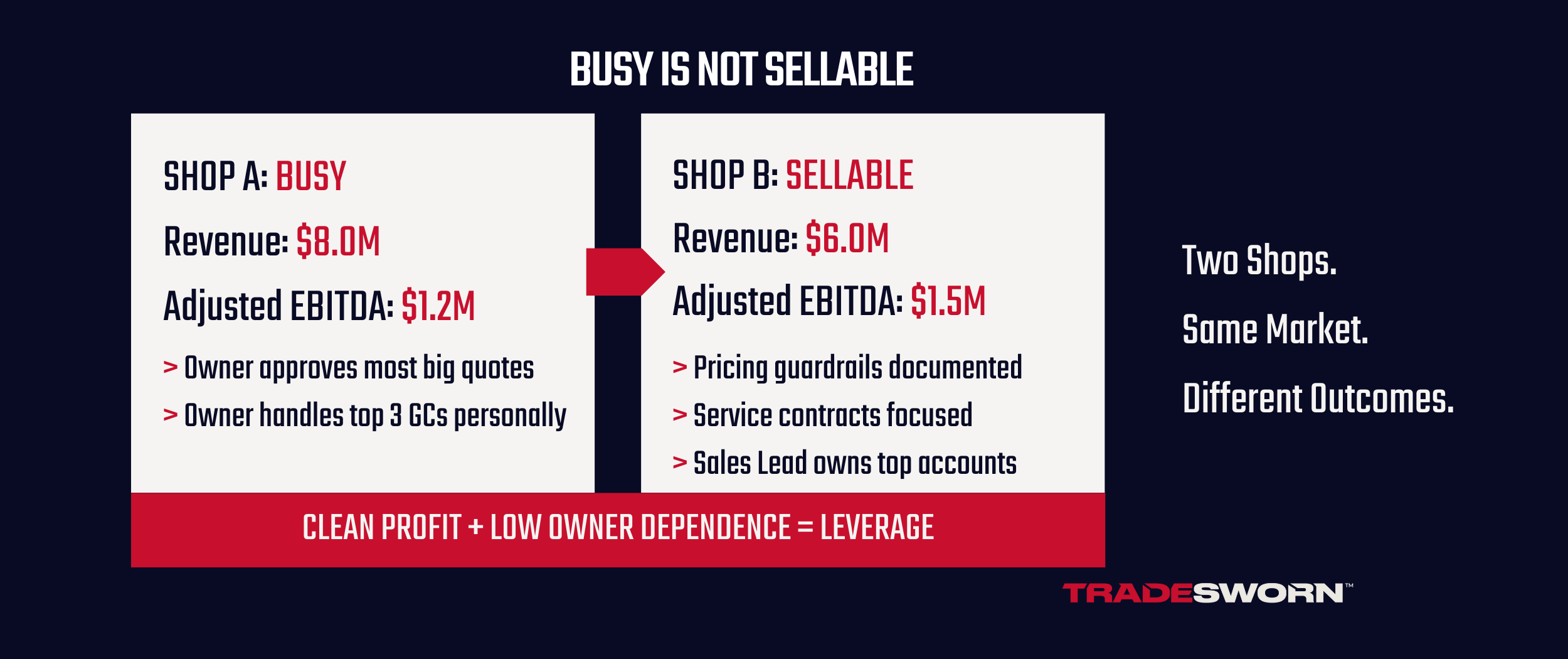
Most serious buyers will lean harder toward Shop B, even though the top line is smaller. Higher, cleaner profit and lower owner dependence usually beats “busy” when it comes time to choose a multiple.
Fix It
• Know your adjusted EBITDA. Strip out personal expenses, one-time hits, and side deals so you have a clean baseline.
• Track trailing twelve months, not just last year. Buyers care more about pattern and resilience than one good season.
• List where you are still the bottleneck: sales approvals, vendor relationships, key customer calls, hiring decisions. Anywhere your name is required becomes a risk line item.
Pro Move
Run a simple test:
If you disappeared for 30 days, could the team still:
• Price jobs inside your target margin band
• Dispatch and close work without you checking every quote
• Collect cash on time and keep vendors paid
If the honest answer is “no,” that is fine. You just found the work that protects your exit value.
Then go deeper on value levers with “What’s My HVAC Company Actually Worth?”
Quick Win
Pick one task you handle that a leader could own this month. Hand off the responsibility with clear guardrails and watch what breaks. Anything that breaks now would have broken under a buyer, too. Fixing it in-house raises your future multiple.
Buyers are not just buying your numbers. They are buying a machine that is supposed to keep running without you. If the only way to understand your business is to sit in your office for six months and shadow every decision, your negotiating power drops fast.
Here is the part almost no one tells you: trying to document every last step before you sell is a trap. Buyers are not paying for a five-inch binder of procedures. They are paying for a few critical flows that are clear, repeatable, and not locked in your head. Over-documenting trivia wastes your energy and still leaves the real machine unexplained.
Here is the straightforward list of what you should be able to produce on demand: IRS records and information employers must keep.
Reality
• Undocumented processes scare serious buyers more than competitive pressure does.
• Confusion around how work flows through your shop becomes a reason to push price down.
• Brokers and buyers listen very closely to how you talk about pipeline, margin, and crews. Vague answers cost money.
Fix It
Build three simple maps:
1. Sales and job flow map: Lead comes in, gets qualified, quoted, scheduled, installed, and collected. One page, boxes and arrows.
2. Customer map: By service type, by region, by size. Show where concentration risk is and where recurring work shows up.
3. Org chart with roles, not just names: Who runs sales, who runs field, who runs numbers. Document what “good” looks like in each seat.
Pro Move
Practice the three-minute explanation you will eventually use with a buyer:
• How revenue shows up
• How jobs move from quote to cash
• How you keep margin from leaking
If you can explain it cleanly to a friend, you can explain it cleanly in diligence. If you cannot explain it without rambling, a buyer will sense that gap and fill it with their assumptions.
To see how confusion turns into lowball offers, read Am I Being Rushed and Lowballed?
Quick Win
Block one hour this week and have a foreman or office lead walk you through how they think the business works, from first call to final invoice. Where their version and your version do not match, you just found documentation you owe your future buyer.
You are not just selling a company. You are handing over your name, your people, and a big part of your identity.
Plenty of deals fall apart late in the process, not because the numbers failed, but because the owner got stuck between “I want out” and “I am not ready to let go.”
Reality
• Burnout and boredom look similar on the surface, but they lead to very different decisions.
• Buyers can sense hesitation, and it shows up as delays, second-guessing, and last-minute haircuts to the deal.
• If you do not know what you are moving toward, you will grab at the first “escape hatch” that shows up, even if it is not a good fit.
Fix It
Ask yourself three questions and write the answers down, not just think them:
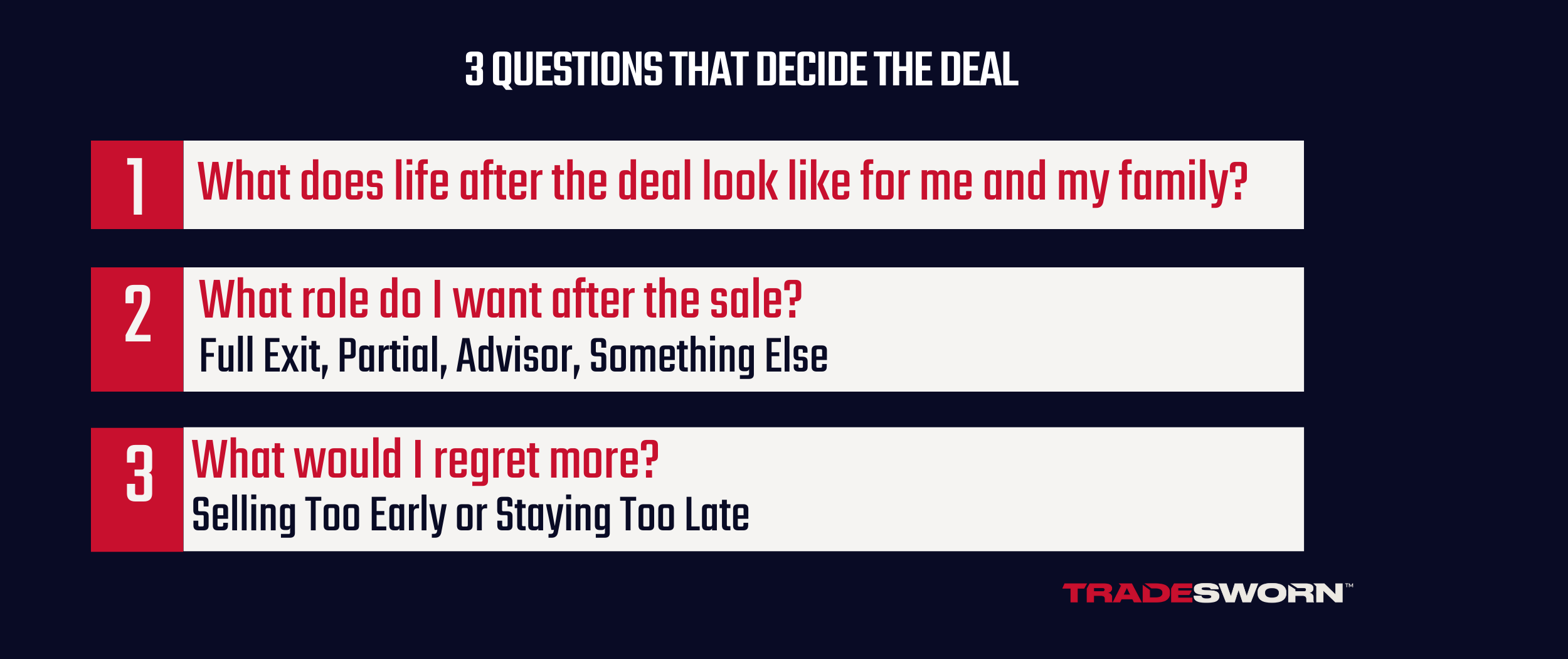
You do not need perfect answers. You need honest ones.
Pro Move
Pressure test your answers by talking with one or two trusted people outside the business: a spouse, a long-time friend, or a mentor who has seen an exit before.
If you find yourself changing your story every time you talk about it, you are not emotionally ready yet. That is a signal to keep building value inside the shop while you clarify your own plans.
If the main fear is burning out before you get there, use “How Do I Exit Without Burning Out?” as a guide for stabilizing the business while you prepare.
Quick Win
Pick one concrete “life after” action you can take now that does not depend on a sale. It might be a standing fishing trip, a weekly no-phone dinner, or bringing in a service manager so you stop running every call yourself. Giving yourself breathing room now makes you a better negotiator later.
You will never feel completely ready to sell. The market does not care about your feelings anyway. It cares about risk and return. That is why treating exit readiness as a score is more useful than treating it as a mood.
Reality
Serious buyers are quietly scoring you on several factors:
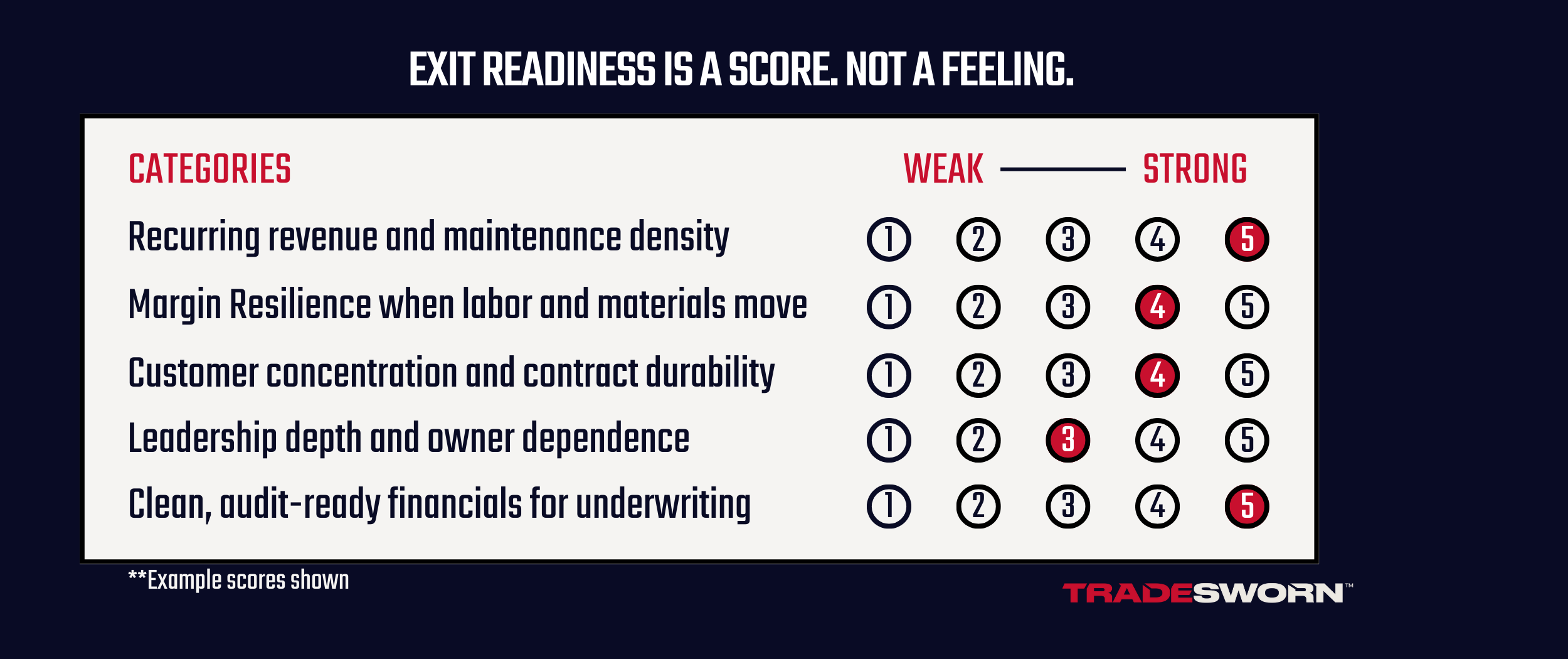
You can ignore that scoring. Buyers score it either way. Score it first.
Buyers also apply known multiple ranges by business profile. Our 2026 commercial HVAC valuation benchmark lays out what closed deals in the $3M-$30M range actually cleared: 3.0-5.0x for install-heavy shops, 4.5-7.0x for balanced mix, 5.5-9.0x for strong recurring base, 7.0-10x+ for platform-ready. Knowing where you sit on that scale changes which gaps are worth fixing first.
Fix It
Build your own simple exit readiness score before a buyer does it for you. Use categories like:
• Revenue mix: service vs install, recurring contracts vs one-offs
• Customer risk: share of revenue from top 5 accounts
• Margin pattern: net margin over the last 8 quarters
• Leadership bench: how many key roles have a clear backup
• Systems: documented processes and basic dashboards
Give yourself green, yellow, or red on each. Do not overthink it. Then run the structured version with the Buyout Potential Scorecard on the Scorecards page so you can see how your shop looks through a buyer’s eyes.
Pro Move
Once you have a baseline score, pick one category to move from red to yellow or from yellow to green over the next 90 days.
• Maybe you diversify the top client list so no single GC is over 20 percent of revenue.
• Maybe you shore up service contracts so your backlog is not just “handshake jobs.”
• Maybe you clean up the financials and start sending yourself a real monthly report.
Tie that improvement work directly into your Exit Workplan so every project you take on now also lifts future valuation.
Quick Win
Before you move on, circle the one category that bothers you the most and write down a 90-day target for it. That becomes the first line item in your exit readiness plan.
If you are even thinking about selling in the next one to three years, you are already in the exit window. The question is whether you will arrive there prepared, or just exhausted.
This HVAC exit readiness checklist is not meant to scare you. It is meant to show you where the real work is:
• Turning busyness into sellable systems
• Making the business explainable without you in every meeting
• Getting your head and your numbers aligned
• Treating exit readiness as a score you can improve, not a feeling you wait for
Your checklist just showed you where buyers will push. The move is not to fix everything. The move is to fix what changes price and reduces dependence first.
If your situation looks like this, the list is long and you do not know what matters most, start with What’s Really Stalling My Exit: Me Or The Business?. It helps you separate motivation blockers from business blockers, so you do not burn a quarter “improving” the wrong thing.
If the real question is whether your numbers support the life you want after the deal, read What’s My HVAC Company Actually Worth? next. Tie readiness work directly to valuation upside.
If the gaps feel heavy, or you are already stretched:
• How Do I Exit Without Burning Out? helps you stabilize your role while you build sellability.
• Am I Being Rushed and Lowballed? protects you if an offer shows up early.
The Buyout Potential Scorecard weights your readiness gaps the way buyers do. When you want this sequenced into a build plan, request your Exit Workplan.
You do not have to sell soon. You do have to be ready.

Here are the top toolkits HVAC owners are reading, using, and sharing to work smarter every week.

Two shops with the same profit can be worth $1M+ apart. Learn how buyers price risk and EBITDA, then improve your number before you sell.

Burnout shows you exactly where the business leans on you too hard. Setup weekly owner blocks, hand off 1 choke point, and survive the exit process.

If an exit feels stuck, it is usually uneven readiness. Spot the real blocker and build a shop that clears diligence cleanly, without panic fixes.

Selling your company shouldn’t feel rushed. Here’s how owners protect their valuation, avoid pressure, and stay in control of the process.

No spam. Get real advice and proven tactics to win more jobs and keep more profit.
“We cut the noise, ran the plan, and made more in two quarters than we did all last year.”
— Sean, Massachusetts

