
A field-tested way to connect every lead dollar to booked jobs, gross margin, and the kind of work your shop actually wants.

Key Takeaway: You don’t need more reports. You need real answers. This post shows HVAC owners how to stop falling for inflated numbers, tie marketing to booked jobs, and finally get clarity on what’s working.
Late afternoon. The ladder flexes under your boots. The sun is still mean. Heat pushes up off the roof like it has a grudge.
Your lead tech is waiting on you to sign off on the scope. Two apprentices are standing by the condenser, pretending not to watch you check your phone. You are already behind. Your screen lights up. A text from the agency rep:
“Great news. Impressions up 40%. Cost per click down 18%. We are trending in the right direction.”
You stare at that message. Then you look back at the unit. At the crew. At the job that took three weeks to land and is already slipping toward a margin you will not brag about.
You type back:
“How many strong commercial jobs did that book?”
Three dots. Then nothing. Because most marketing reports are built to look good. Not to tell the truth.
This post is the truth test. Not for ads alone. For everything that claims it can create demand for your commercial HVAC shop.
If you already have your definition of “working” and you are ready to cut, fix, or scale specific paid channels, go to Which Channel Is Just Burning Cash?
Reality
Most shops never define what “working” means. So every channel gets to invent its own results story.
Paid wants clicks.
SEO wants traffic.
A sponsorship wants vibes.
Referrals just want gratitude.
Your business needs margin and fit.
Fix It
Marketing is only working if it hits all three:
If any one of those fails, you are not scaling. You are feeding a machine that eats your week.
Pro Move
Put this on one page and treat it like law:
Then give that page to anyone touching your demand engine. If they cannot report to these lines, they are not measuring your business. They are measuring themselves.
Even Hotjar recommends judging campaigns by business outcomes like qualified leads, conversions, and ROI, not surface metrics like impressions or clicks.
Quick Win
For the next 10 inbound leads, label each one:
No debate.
No spreadsheets.
Just honesty.
You just started your Lead Scorecard with real field judgment.
If you want the cleanest measurement model without turning this into a science project, Google’s Modern Measurement Playbook lays out how to combine attribution, experiments, and marketing mix models so your ROI table reflects reality.
Reality
Owners usually track marketing like this:
“What did we spend on ads? What did we get from ads?”
That is clean. It is also incomplete.
Your demand spend is bigger than paid search. And your leak might not be where you are staring.
Fix It
Look at the last 90 days and pull every acquisition dollar, including:
Put it in one simple grid:
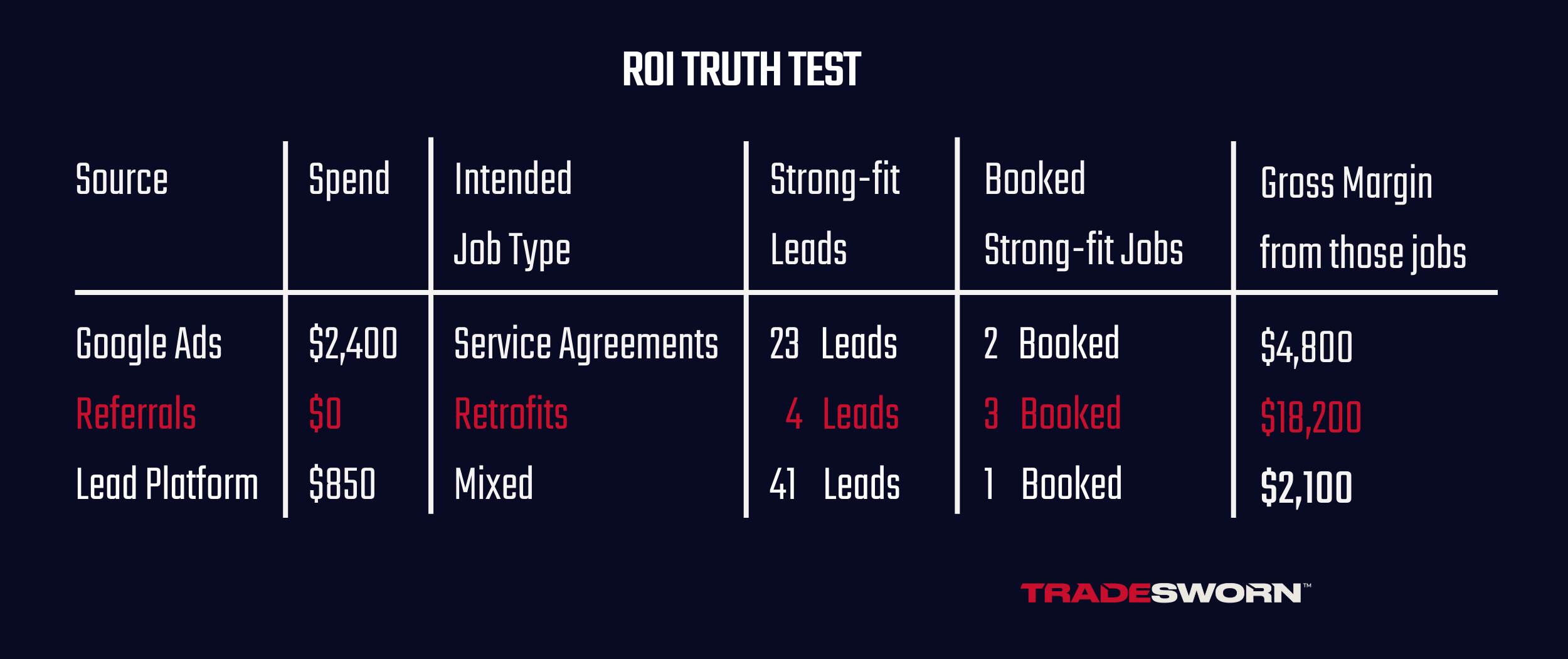
Now you can see the lie. The “free” channel out-produced the shiny channel. The high-volume channel barely survived contact with reality.
Pro Move
Run the margin-first formula:

If that number is thin or negative, you do not have a marketing problem. You have a business model mismatch between what you buy and what you can profitably deliver.
Lead volume is not the goal. Lead contribution is.
Quick Win
Ask every new caller one question and log it for two weeks:
“How did you hear about us?”
You will get enough signal to challenge the prettiest report in your inbox.
Want a hard benchmark, not opinions? ACCA’s Contractor of the Future study highlights show that contractors allocating at least 12% of revenue to marketing can see net profits move from 5% to 9% when the rest of the system supports it.
Most owners get trapped by cost per lead. So they fund the wrong engine longer than they should.
Shop A vs. Shop B
Both spend $2,000 per month.
Campaign A
Result: The report celebrates. The bank account does not.
Campaign B
Result: Fewer leads. Better business.
Your best channel might be the one that generates the fewest leads.
Reality
You can look “busy and growing” while your lead engine is quietly poisoning your job mix. That is how shops end up booked solid and cash confused.
Fix It
Track these monthly:
This is the minimum you need to stop guessing.
When you need to prove whether a channel is actually adding booked margin, not just creating activity, The Effectiveness Equation explains why incrementality tests are the gold standard, and how to pair them with attribution and marketing mix models.
Pro Move
Add one more layer most shops miss: Lead survival rate
How many good leads die in the first:
If your best leads are dying on intake, marketing is not your bottleneck. Your phone and dispatch system is. Most shops do not have a lead generation problem. They have a lead survival problem.
Quick Win
Pull your last 20 missed calls or unreturned form fills. For each one, note:
If more than 5 of those 20 went dark after slow response, your survival problem is bigger than your lead generation problem.
Reality
When the truth is fuzzy, owners do one of two things:
Both are emotional decisions pretending to be strategy.
Fix It
Classify each source into:
This is a whole-system call, not a platform argument.
Pro Move
Use the stack order to remove waste:
You do not need five new initiatives. You need one bottleneck move.
Quick Win
Schedule a 30-minute Lead Scorecard review on the first Monday of next month. Bring:
No opinions without numbers. No numbers without examples.
Marketing is not working because traffic is up. It is working when your shop is booking strong-fit jobs at margins that still make sense on a hard week.
If you cannot connect spend to booked strong-fit gross margin, you are not measuring performance. You are renting hope. And hope does not scale.
Most shops realize the problem is not one channel. It is the whole system. That is why this stack exists in this exact order.
You just defined what “working” means. Hold the line. If you cannot point to booked strong-fit gross margin, it is not working.
If your situation looks like this, spend is happening but the return feels fuzzy, start with Which Channel Is Just Burning Cash?. It forces every channel to survive a margin test, not a click report.
Then pick the right next read based on what you see:
• Am I Targeting the Wrong Job Types? if volume is up but the calendar is filling with the wrong work.
• Why Aren’t Calls Turning Into Jobs? if good leads are calling and dying at the front door.
• Why Are Our Leads Weak: My Strategy Or Our Lead System if the whole demand system feels soft and you want to see whether your biggest gap is who you attract, how you convert, or both.
Run this Lead Quality Check to baseline lead fit and follow-through. When you want to rebuild the engine instead of guessing at knobs, request your Customer Leads Workplan.

Here are the top toolkits HVAC owners are reading, using, and sharing to work smarter every week.

Audit every marketing channel by what it costs to book real work, not cheap leads. Finally see what earns its spot and cut the rest.

Fix the first 60 seconds with two-lane intake, four-question qualification, and booked next steps so good leads stop dying in your own phone system.

Your phones ring, but the leads feel wrong. Separate a targeting problem from a follow-through problem, then fix the real bottleneck.

Stop stuffing your calendar with C-work. Run the A/B/C job audit to protect crew time and margin from the jobs that quietly drain both.

No spam. Get real advice and proven tactics to win more jobs and keep more profit.
“We cut the noise, ran the plan, and made more in two quarters than we did all last year.”
— Sean, Massachusetts

