
Cheap service calls might be stuffing your calendar. We show you how to refocus your ads to land higher-margin installs and contracts.

Key Takeaway: A full pipeline isn’t always a profitable one. The wrong jobs fill your schedule but bleed your margins. Learn how to flip your mix, boost profit per job, and stop chasing work that doesn’t pay.
It is Friday afternoon and the board is full. Columns stacked. Next week looks jammed.
The air in the shop has that late-week smell of sweat, dust, and half-cold coffee. Crews are dragging in from the field, sunburned and beat. Your service manager taps the board with a marker.
“Good problem to have. We are slammed.”
You nod, but you are already doing different math. Too many small, scattered nuisance calls. A couple of low-margin replacements that ate a ton of hours. One solid retrofit you had to push because the right crew was buried.
Payroll is heavy. Overtime is creeping. Gross margin is thinner than it should be.
Part of you wants to celebrate the volume. Part of you wants to start saying no. The smarter part knows neither move is the point.
You are not short on work. You are short on the right work.
The question is not how do we get more jobs. It is whether we are targeting the wrong job types in the first place.
This is not a job-costing post. This is a targeting and pipeline filter post.
Reality
Every commercial HVAC shop lives with some version of this split:
Jobs that pay fairly, fit your crews, and lead to customers you want again.
Jobs that burn hours, chew up technicians, and barely move the bank account.
Over time, the mix of those jobs controls three things owners feel every week:
Profit. Fatigue. Future options.
Most owners do not end up with a bad mix on purpose. It happens one yes at a time.
“We can squeeze that in.”
“We do not want to say no to that general contractor (GC).”
“We are already out that way, might as well.”
The board fills up. The bank account does not keep up.
Fix It
Do not treat job mix as a scheduling problem first. Treat it as a targeting problem.
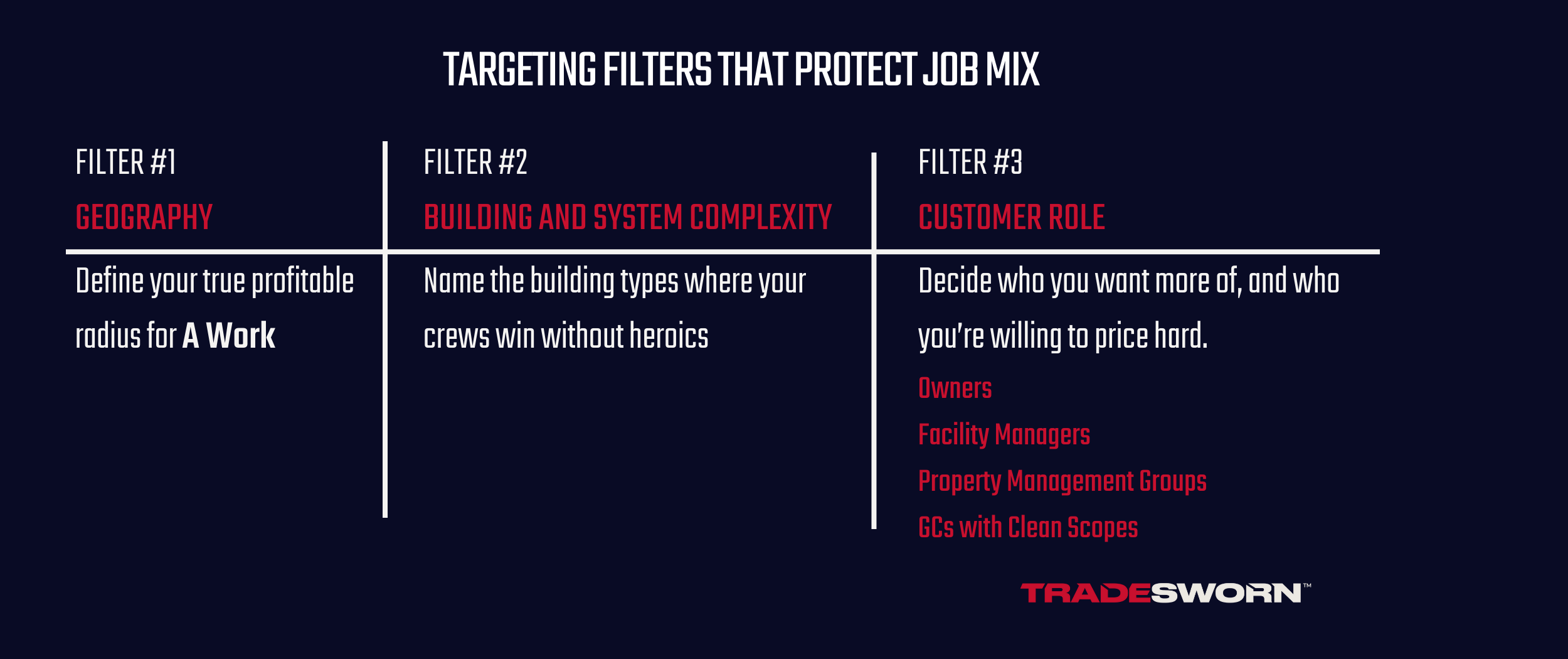
Job mix is decided by a chain of choices that starts before estimating:
If any of those three are loose, the rest of the shop has no chance.
Pro Move
Saying yes to everything is not customer service. It is a refusal to design your business.
Most owners think turning down work makes them look small or picky. In reality, the shops with the clearest nos tend to have the strongest margins and the least chaos.
A strong call center can still drive a bad mix if the front door is letting in disorder.
Quick Win
Write this sentence at the top of your next leadership huddle agenda.
“We are not chasing more work. We are chasing more of our best work.”
If that sentence makes anyone uncomfortable, this post is for you.
In this YouTube video — “Can I STILL do this? Tech Burnout” — a veteran tech shares how repetitive, low-value jobs crush morale over time, making it harder to retain and motivate your best field crews.
Reality
Most shops have a default category for jobs.
“All of it is good because we are busy.”
That mindset is how C work hides in plain sight.
Fix It
Take the last 90 days of completed jobs and sort them into three buckets.
A-jobs.
Do these all day.
Right size, right margin, right customer.
Work you would proudly repeat.
B-jobs.
Fine, but forgettable.
They keep the week full but do not change profit or positioning.
C-jobs.
Never again if you can help it.
Wrong fit customers, ugly locations, awkward scope, shaky price discipline, or chronic change order pain.
Now add the layer most owners skip. Next to each job, write the lead source that fed it:
Search.
Referral.
Property manager relationship.
Lead marketplace.
A GC you cannot quit.
You are building a simple map of which channels feed A-work and which feed the headaches.
Example snapshot from one shop’s 90-day audit:
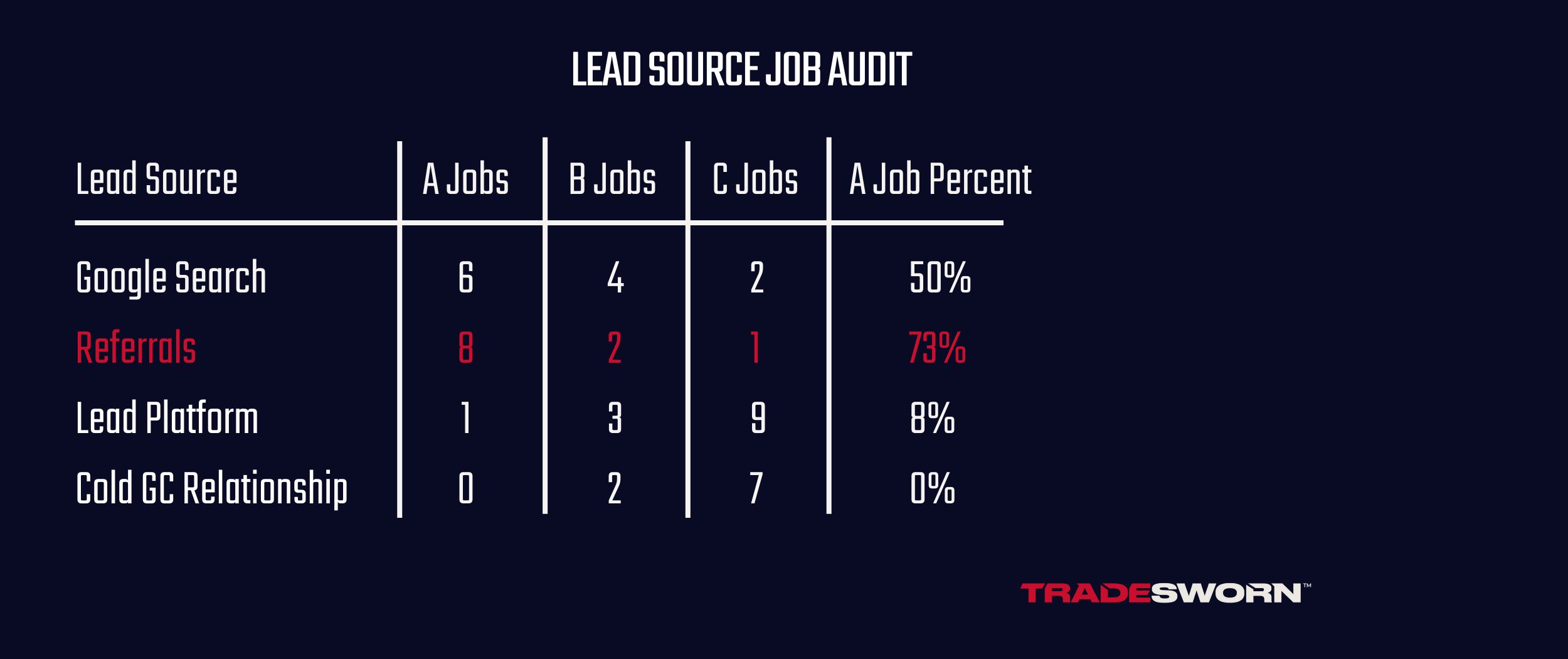
Now the pattern is obvious. Referrals feed A work. Lead marketplaces feed C work at an expensive rate. That one GC relationship is a pure C-factory.
You are not guessing anymore about where to reallocate effort. You are looking at the map.
Pro Move
Your C work is not just low-margin. It is training the market to send you more C-work.
When you say yes to the wrong jobs, you become known for the wrong jobs. Property managers talk. GCs remember. Word spreads about what you will tolerate. Six months of C-work builds a reputation that takes two years to shake.
Quick Win
Pick ten recent jobs. Label them A, B, or C. Write the lead source next to each.
You will usually see a pattern in under fifteen minutes.
Reality
Job mix improvements can feel abstract until you attach the change to gross margin.
Fix It
Run a simple thought experiment. Look at your last 90 days.
How many C-jobs did you really need to say yes to.
How many could have been replaced with A-level work if your targeting filters were tighter.
If you could have shifted just six of those C-jobs into A-jobs, what would that have changed.
Directional is enough to unlock the truth.
Pro Move
Run the math with real numbers from your last quarter.
Example from a $8M commercial shop:
Last 90 days they completed:
The gap: $35,200 in gross margin left on the table in one quarter.
Not because they were lazy. Because their targeting filters let the wrong work in, and their intake system treated every call like a win.
Multiply that by four quarters. About $140,000 a year. That is not a rounding error. That is a crew chief’s salary and truck. Or the margin buffer you have been missing every slow month.
The jobs you say no to matter more than the jobs you win.
Most shops track close rate on qualified leads. Almost no shops track what they declined and why. But your nos define your positioning faster than your yeses.
Quick Win
In your next weekly meeting, ask one question.
“If we had to drop three jobs next week to protect our best crews, which three are the easiest no.”
Those are almost always C-work wearing a busy disguise.
Reality
Most mix problems start upstream. You can fix estimating habits and still drown in the wrong calls if your ads and offers are aimed too wide.
Fix It
Turn your A-jobs into a simple targeting profile. Look back 6 to 12 months and list your best work. For each, note:
Job size range.
Building type.
Decision maker.
Location and travel time.
Why the job was smooth.
Then turn those repeats into three filters your marketing and intake teams can use:
Pro Move
Audit ads, landing pages, and scripts for accidental invitations.
Example targeting defect: If you are chasing multi-site service contracts as A-work, but your search ads are still buying terms like “HVAC repair near me” or “commercial AC service cost,” your ads are actively defeating your strategy.
Shift budget toward higher intent phrases that match your A-profile, such as “facility maintenance contract bid” or “variable air volume (VAV) box replacement service.”
Real before and after snapshot from one shop’s audit:
Before (feeding C work):
After (filtering for A-work):
Results after 90 days:
They did not get more leads. They got fewer, better leads that turned into work their crews actually wanted.
The point is not to copy these exact numbers. The point is to measure the shift in your own shop using the same logic. Clarity is a filter.
Quick Win
Rewrite one sentence on your website this week. Replace a generic claim with a specific promise tied to A work.
From: “Full-service commercial HVAC.”
To: “Retrofit and replacement for mid-size offices and light industrial buildings within [x] counties.”
Even a small change like this starts training the market.
Reality
If your intake process treats every caller the same, your best opportunities pay the price.
A-jobs get slower response times. A-jobs wait behind noise. Your best technicians get assigned to whatever screams the loudest.
Fix It
Add a simple three-question qualifier for new inbound leads.
You are not interrogating them. You are routing the right calls to the right next step.
Pro Move
Create an A, B, C lead tag in whatever system you have, even a spreadsheet.
If a lead is clearly C, you can still help them. But you stop letting C-leads set the pace of your week.
Quick Win
Pick one intake rule you will test starting Monday morning.
Rule 1: Minimum project size for retrofit bids
Rule 2: Priority routing for A-profile buildings
If you cannot write the rule and the Monday action, you are not ready to improve the mix yet.
One Week Job Mix Reset
You do not need a quarter to start.
Day 1
Pull 90 days of completed jobs. Mark each as A, B, or C.
Do not overthink the definitions.
A-jobs are jobs you would proudly do ten more times.
C-jobs are jobs you wish you had declined.
Day 2
Tally job counts and rough gross margin by bucket.
Most shops are shocked by two numbers.
How many C-jobs they actually completed.
How little those C-jobs contributed to total margin.
Day 3
Define A-jobs in plain language with your leadership team.
Write it on one page.
Building type. Job size. Margin. Customer role.
This becomes your targeting filter for everything that follows.
Day 4
Share that definition with sales, estimating, and dispatch.
Ask what rules or habits block more A-work.
Day 5
Pick one upstream filter to tighten in marketing and one downstream rule to tighten in intake.
Day 6
Add A, B, C mix tracking to your Lead Scorecard.
Day 7
Stand at the board and ask:
“Does this week look like the kind of business we want more of, or the kind we are trying to leave behind?”
You will not fix everything in a week. But you will stop pretending job mix is random.
If your lead engine keeps feeding you C-work, your team will keep paying the price in overtime, frustration, and thin profit.
This post is not about being picky for ego. It is about designing the front door so your best work has room to land and your best people have room to grow.
The industry is tight on labor, which makes the “keep your best people” part non-negotiable. This is not just your shop. AGC’s workforce survey is a strong outside proof point on how widespread the labor constraint is.
Job mix is a choice disguised as a calendar. You just named the work you want. Make it the filter upstream.
If your situation looks like this, you keep landing C-work even when you do not want it, start with Which Channel Is Just Burning Cash? and track booked margin by source. Cut what feeds the wrong mix.
Then use Is My Marketing Actually Working? to confirm your definition of “working” is tied to margin, not busyness.
If good leads fit but calls are not booking, Why Aren’t Calls Turning Into Jobs? tightens the front door so targeting work does not leak.
If the whole system still feels soft, start with Why Are Our Leads Weak: My Strategy Or Our Lead System.
Track your A, B, C split with the Lead Quality Check. When you are ready to turn A-work into a demand system, request your Customer Leads Workplan.

Here are the top toolkits HVAC owners are reading, using, and sharing to work smarter every week.

Fix the first 60 seconds with two-lane intake, four-question qualification, and booked next steps so good leads stop dying in your own phone system.

Stop chasing vanity clicks. Track what actually converts to booked jobs and margin so you know what's working and what's just noise.

Your phones ring, but the leads feel wrong. Separate a targeting problem from a follow-through problem, then fix the real bottleneck.

Audit every marketing channel by what it costs to book real work, not cheap leads. Finally see what earns its spot and cut the rest.

No spam. Get real advice and proven tactics to win more jobs and keep more profit.
“We cut the noise, ran the plan, and made more in two quarters than we did all last year.”
— Sean, Massachusetts

