
Tighten what happens in the first 60 seconds so the strong-fit leads you already earned do not die inside your own phone system.

Key Takeaway: Call conversion is not a lead problem. It is a front-door system problem you can fix fast by defining conversion, running a two-lane intake, and enforcing four questions and a booked next step before the call ends.
You are still in the truck. Coffee in the cupholder. Site visit notes spread across the passenger seat.
A property manager you have been trying to win for two years.
A building you already know.
A chance you do not get twice.
You hear two rings before someone at your office answers.
Then silence.
Then a nervous hello.
Then a rushed transfer.
Then voicemail.
By the time you get the recap, the lead is marked as “price shopping.” You stare at that note in your Customer Relationship Management (CRM) system.
Price shopping. Maybe. But there is a more uncomfortable truth that fixes the problem faster.
The shops that complain loudest about lead quality usually have the loosest intake systems.
It is easier to blame the market than to listen to your own calls. But when you replay what happens in the first 60 seconds, the problem is rarely the caller. It is the chaos on your end.
This post is about tightening the front door so the leads you already earned do not die in the hallway.
Reality
Calls die for three boring reasons.
These sound simple because they are. That is why they are so expensive.
One shop’s real audit:
They tracked 50 strong-fit inbound calls over two weeks.
Result: Out of 50 strong-fit calls, only 11 booked a next step.
That is a 22 percent conversion rate on leads they paid good money to generate.
The problem was not the leads. It was the first 60 seconds.
Fix It
Redefine what “conversion” actually means. Use one simple definition:
A call converts when a strong-fit caller books the next best step before you hang up.
The Difference in Practice
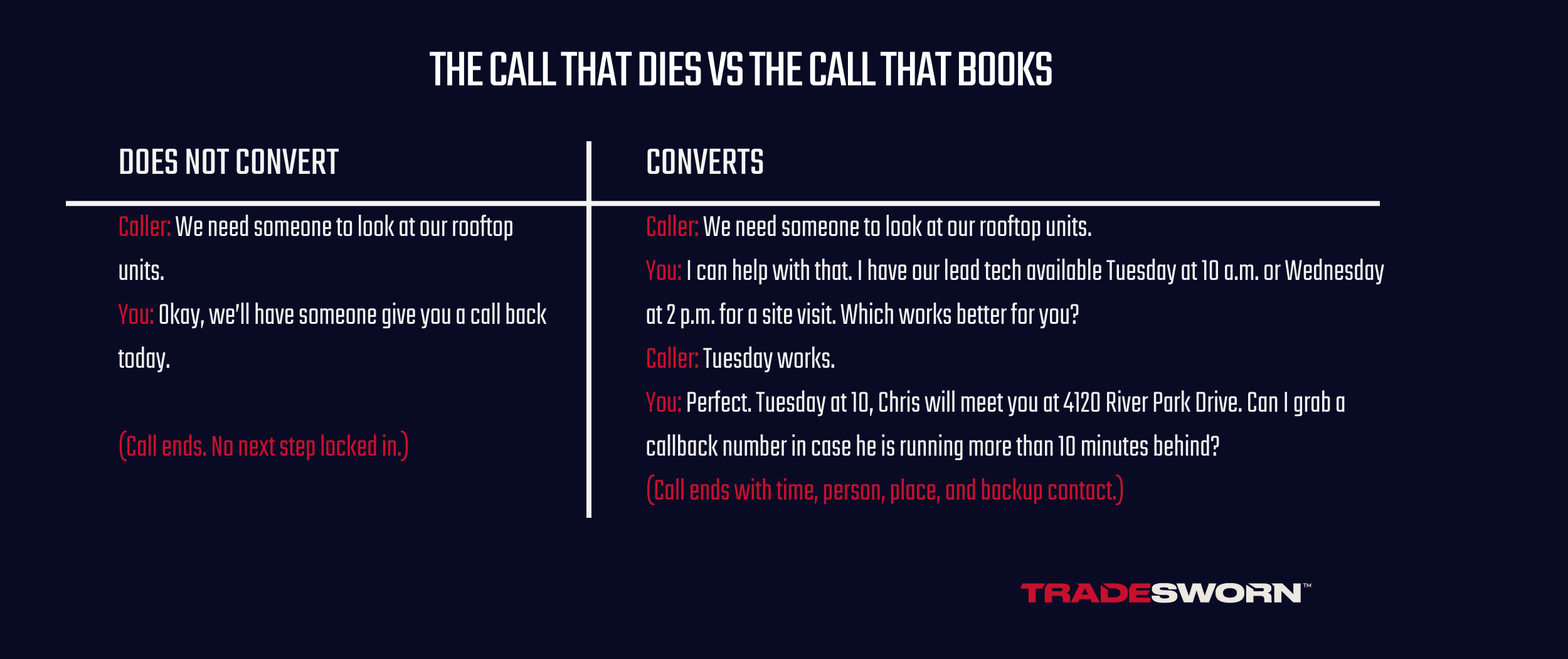
The second version books the job.
The first version hopes the caller stays interested.
Pro Move
Audit calls while they are still live. Most shops audit calls after they are already lost. Elite shops audit them while they are still live.
The shops with the tightest call conversion do not tune annually. They tune weekly.
Quick Win
The 10-minute daily recovery protocol. Tomorrow morning, before you check email:
One shop’s 30-day result:
They recovered 4 of 7 strong-fit missed calls per week.
Average gross margin per recovered call was about $4,200.
Monthly recovered margin was about $67,000.
That is more margin than most ad campaigns produce. And it cost zero dollars.
If you want outside benchmarks to sanity-check your own numbers, Invoca’s call conversion benchmark report coverage is a useful reference point for how phone-led demand behaves across service categories.
Reality
Most shops treat every caller the same. It feels fair.
It is not protective. Treating every caller the same is not fairness. It is refusing to protect your best opportunities.
When your best lead from a major facility waits behind three off-profile requests, you are not being democratic. You are being inefficient.
Fix It
Run two lanes.
Lane A gets speed, senior attention, and a booked next step. Lane B gets courteous clarity and a controlled next action, or a clean decline.
Pro Move
Engineer chaos out with mandatory CRM fields.
You cannot train people out of chaos. You must engineer the chaos out of the system. Do not rely on memory when the phone is ringing.
Make your system demand the filter. In your CRM or dispatch tool, make these fields mandatory before a strong-fit job can be created:
If the intake person cannot complete these fields with confidence, the ticket routes to a senior coordinator or owner for approval. This hardens protects your marketing spend in real time.
Quick Win
Add one Lane A trigger to your greeting today. Example:
“ABC Commercial HVAC. Is this about a service call, a maintenance agreement, or a retrofit or replacement project?”
This is a sorting gate, not a full script rewrite.
Reality
You do not need a ten-minute script. You need four questions that protect your time.
When qualification is loose, your best work waits behind chaos and your team starts calling everything “price shopping.”
Fix It
Use the four-question filter in the first 90 seconds.
These questions are not about being picky for ego. They are about keeping your best work from waiting behind chaos.
If your team needs a clean mental model for “calm, confident, helpful” on the phone, this piece on creating exceptional customer experiences reinforces the behavior you are driving.
Pro Move
Run one 90-second role-play block every Monday. Pick five real recent calls. Practice the four questions. Practice booking the next step with two time options.
Short reps keep the system sharp.
HVACR Business notes that cross-training customer service reps (CSRs) and sales reps can lift booking rates and confidence. The key is treating every call as both a service moment and a sales opportunity.
Quick Win
Print the four questions and tape them next to every phone or monitor where intake happens. Add one reminder line at the bottom:
“Lane A callers: Offer two time slots before you hang up.”
Visible beats memorable. Test it for one week, then check your strong-fit booking rate.
Reality
Most owners assume weak results mean weak leads. The truth is, your best salespeople cannot close leads your intake team already killed.
Fix It
Real transformation from one shop:
Results after 60 days:
Same marketing spend. Same lead flow. Different first 60 seconds.
Pro Move
Make call conversion a monthly operating metric. Track two numbers every month:
If either one slips, you do not need a new campaign. You need a tighter front door.
Quick Win
Choose one non-negotiable this week. Examples:
Write it down. Train it. Measure it next Friday.
Fixing call conversion does four things fast:
This is not about working harder on the phones. It is about designing a front door that your best work can trust.
Fix the first 60 seconds, and your marketing finally shows up in the numbers. Ignore the first 60 seconds, and no amount of ad spend will save you.
You already paid for the phone to ring. Intake is where that money either turns into jobs or evaporates.
If your situation looks like this, leads are coming in but jobs are not booking, start with Why Are Our Leads Weak: My Strategy Or Our Lead System. It tells you whether the leak is fit or follow-through.
<p>If the jobs booking are still the wrong type, go to Am I Targeting the Wrong Job Types? before you spend another dollar feeding the wrong calendar.
Then connect conversion back to spend:
• Is My Marketing Actually Working? for the margin view.
• Which Channel Is Just Burning Cash? for the cut or reallocate call.
Use the Lead Quality Check to track lead survival from call to booked job. If booking is still under 50 percent on strong-fit calls after tightening intake, request your Customer Leads Workplan.

Here are the top toolkits HVAC owners are reading, using, and sharing to work smarter every week.

Stop chasing vanity clicks. Track what actually converts to booked jobs and margin so you know what's working and what's just noise.

Stop stuffing your calendar with C-work. Run the A/B/C job audit to protect crew time and margin from the jobs that quietly drain both.
Your phones ring, but the leads feel wrong. Separate a targeting problem from a follow-through problem, then fix the real bottleneck.

Audit every marketing channel by what it costs to book real work, not cheap leads. Finally see what earns its spot and cut the rest.

No spam. Get real advice and proven tactics to win more jobs and keep more profit.
“This is the stuff no one tells you. We’re making more with less stress.”
— Louis, Texas

